Binary stars: It Takes Two to Tango
Authors: Lieke Van Son (Lead), Matthias Fabry, Annachiara Picco, Lucas de Sá
Overview
Most stars don’t live alone, but have a companion which whom they preform a cosmic dance throughout their lives. The interactions with their companion star, like mass transfer, tidal synchronization and common-envelope evolution, fundamentally reshape the stars’ structure, rotation, and ultimate fate. This is the cause for some of the most energetic phenomena in the universe such as X-ray binaries, stripped-envelope supernovae, and gravitational-wave mergers of black holes and neutron stars!
Today, we will learn how to use MESA/binary to trace this journey from the first interaction to the final merger.
The figure below sketches the binary evolution path that stars can take towards a double black hole (BBH) merger, which provides the overarching narrative for the three labs:
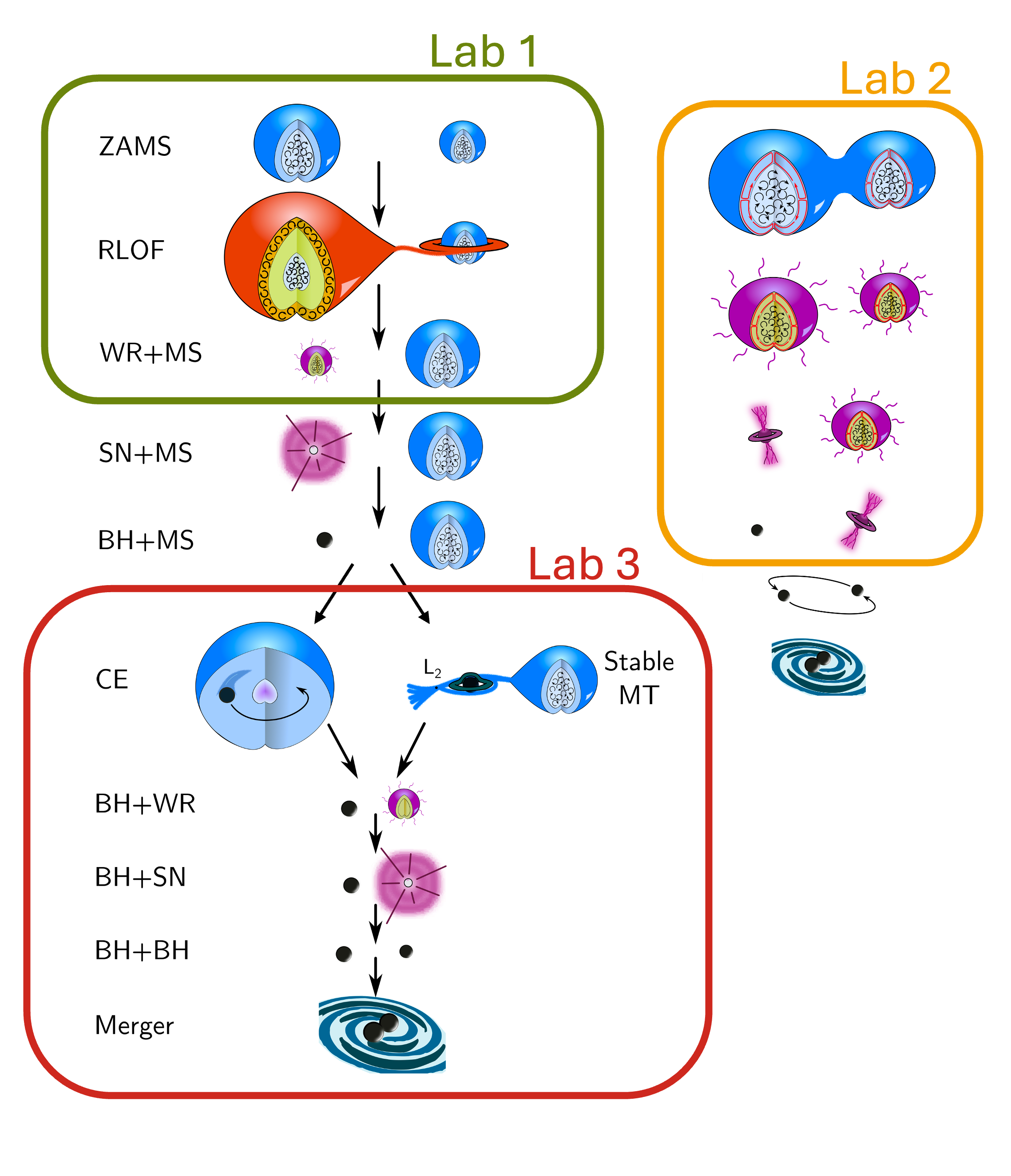
The three labs today each zoom in on a key stage of this journey:
Lab 1 Give and Take: First mass-transfer event (RLOF): how the donor transfers mass, how the accretor receives it, and how the orbit responds.
Lab 2 Stellar Swinging: We will investigate the effects of rotation and how this can induce `chemically homogeneous evolution’ in very tight binaries. How will stellar swirling affect the final black hole spins?
Lab 3 Stable Relationships: Picking up the post-mass-transfer systems from Lab 1, we will ask how the binary continues its evolution and whether it could eventually form a double compact object (merger)?